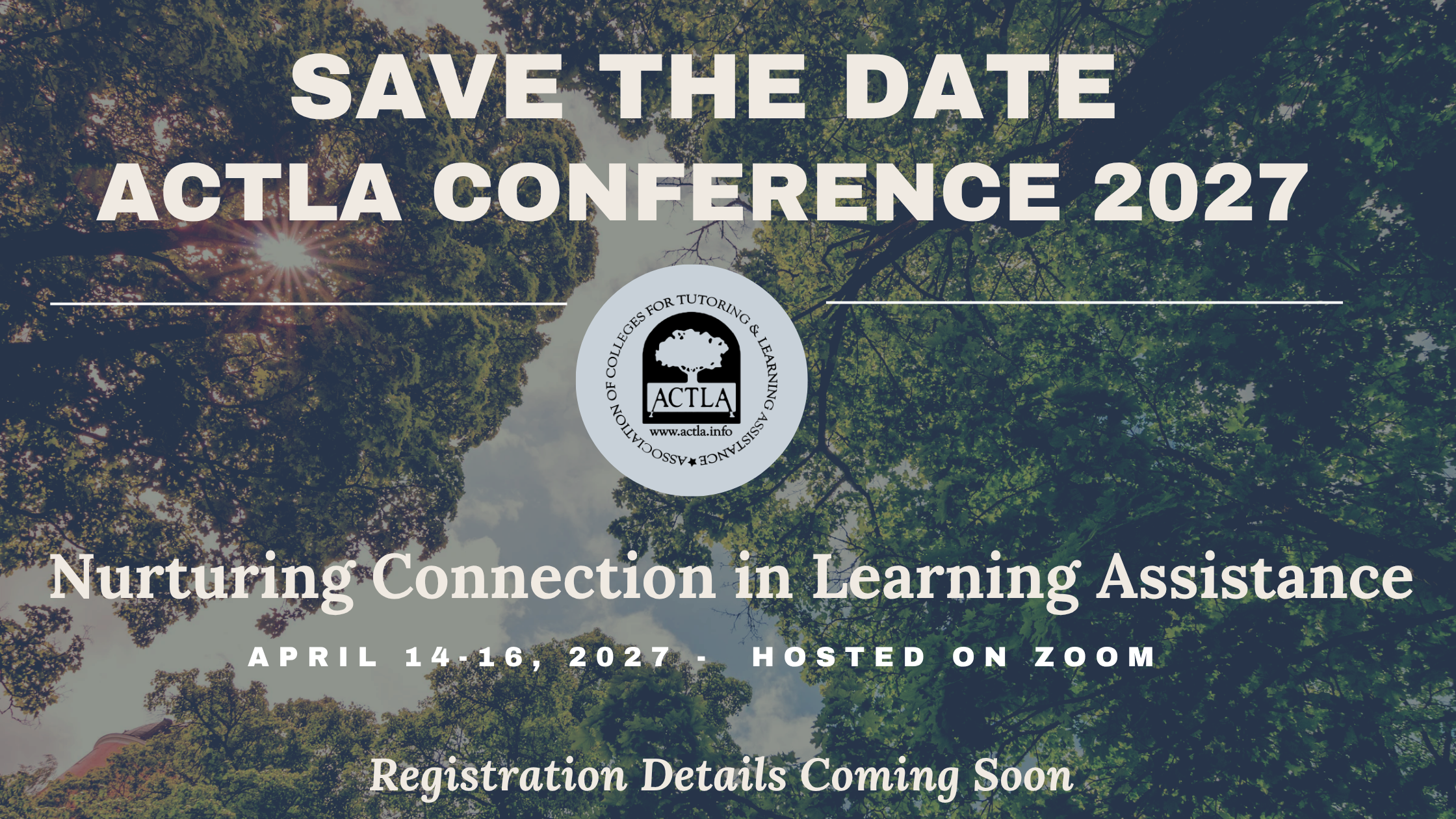
Nurturing Connection in Learning Assistance
Learning Assistance is rooted in connections between ideas, peers, and partners. We nurture this work by establishing a shared belief that everybody deserves opportunities, structures, strategies, and resources to thrive .
We invite you to ACTLA’s 52nd conference: Nurturing Connection in Learning Support, hosted on Zoom Events. Conference attendees will reflect on how our practices, partnerships, and programs can build a stronger sense of connection and advance student success in an evolving educational environment.
Let’s share insights, cultivate new and existing relationships, and explore opportunities to nurture connections in our learning centers, across our campuses, and within our professional networks.
Conference Strands, Pricing, Format
-
Conference Strands
Our Conference Strands (or topics) shape what you can expect from this conference. We picked topics that are relevant to our field, will encourage thoughtful and interesting conference sessions, and feel authentic to ACTLA.
READ MORE BELOW
-
Pricing
We encourage all learning center professionals (new and established), faculty affiliated or interested in learning centers, students who use services at learning centers and student peer educators to attend.
Early Bird (Nov. 2026 - Feb. 19, 2027): $250
Regular Bird (Feb. 20, 2027 - Mar. 19, 2027): $275
Sleepy Bird (Mar. 19, 2027 - Apr. 9. 2027): $300Conference Presenter Price: $250
Students (undergraduate & graduate): Free
-
Format
Hosted on Zoom Making our conference accessible from anywhere, at any time.
After the conference, all registrants will have access to all recorded sessions for one year.
2027 Conference Strands
Technology always works! Or does it? Technology can be an excellent learning tool, but with additional modalities for collaborating, working, and learning, we have a variety of technology to choose from, peer educators to coach and train on those technologies, and boundaries to set. From Zoom meetings to GenAI to a fun app you use in your sessions or training, technology brings new rules and opportunities to the playing field.
Guiding Questions for Conference Proposals
For Learning Center Professionals
How can technology help you build community?
In what ways can learning centers lead meaningful engagement with technology?
How do you train your students to use AI to support their learning?
For Peer Educators and Students
How do you utilize social media to build community and lead to meaningful engagement?
How are you interrogating the use of AI in our sessions? Should we?
Authenticity with Technology
1
Learning centers have the opportunity to connect students to more than just their tutor. As advocates for peer tutoring, we must ask how we can best foster collective and collaborative learning. We are interested in knowing how to connect with students, how to connect students with other students, and how to make them feel connected to a larger community as a whole. Collective and collaborative learning can be done on campus or off campus, in our centers or outside of our centers. We are interested in knowing how to foster this connection and what the positive results of these connections are for our centers and our students.
Guiding Questions for Conference Proposals
For Learning Center Professionals
How do you connect with students and connect them with each other?
How do learning centers exercise their role as community centers for campuses?
How do learning centers support student community-building outside of our centers?
How have you connected with other centers or programs on your campus or outside of your campus?
For Peer Educators and Students
How do your sessions support student community-building?
How have you built community with your fellow peer educators?
What opportunities do you see for learning centers to help build community at your campus?
Collective and Collaborative Learning
2
When we dream about outstanding learning and leadership in the future of our centers, what do we envision? Explore how leadership, advocacy, and data can help us create transformative learning environments. Consider how all educators, including faculty, staff, administrators, and peer educators can shape learning center culture, policy, and vision.
Guiding Questions for Conference Proposals
For Learning Center Professionals
What do you envision for the future of learning centers, and what data informs those visions?
How do you advocate on behalf of our peer educators and students?
What does supporting the individuals involved in this work look like and what does it mean? The affective impact - how we feel at work–and structural impact - resources, pay, schedule, professional development/training, work location.
For Peer Educators and Students
How do peer educators communicate, lead, influence, and shape the learning culture in our centers and beyond?
What do you envision for the future of your learning center?
Leadership, Visioning, and Dreaming in
Learning Centers
3
Best Practices for Promoting Learning, Socio-emotional Wellness, and Community
4
Learning centers play an important role in supporting and developing peer learners’ sense of connection, community and sense of belonging. We are interested in hearing your stories and experiences surrounding connection and social wellness in your work.
Guiding Questions for Conference Proposals
For Learning Center Professionals
What have been the most successful collaborations with campus partners in learning center work?
What pedagogy/teaching philosophies/training topics have been the most impactful to your peer educators? What’s working?
How do you embed wellness practices or the affective domain into your training, learning centers, or pedagogy?
For Peer Educators and Students
What learning strategies have been most impactful (most fun, engaging, thoughtful, difficult) in your sessions?
What do you need to feel supported in order to thrive in your role as a peer educator?
How do you embed wellness practices or the affective domain into your peer engagement?
Equity and Social Justice
5
Learning Centers have been hubs for equitable access and student empowerment by implementing inclusive teaching and facilitating practices that encourage meaningful and durable learning. If we aim to continue this work, equity and social justice must be at the center. Our students are shifting and changing; they are different from the students we served 5 years ago and have different attitudes on the value of higher education. How does your learning center continue to ground itself in equity and social justice?
Guiding Questions for Conference Proposals
For Learning Center Professionals
How is your Learning Center transforming, advocating, and promoting policies, practices, and spaces for equity and social justice?
How is your learning center training peer and professional staff on supporting diverse demographics?
How does your learning center affirm student learners who represent diverse demographics?
For Peer Educators and Students
How is your learning center helping peer educators gain skills to help them engage in a diverse world beyond graduation?
How are you affirming the “whole” student? What are strategies or activities that you do in your sessions that center the “whole” student?